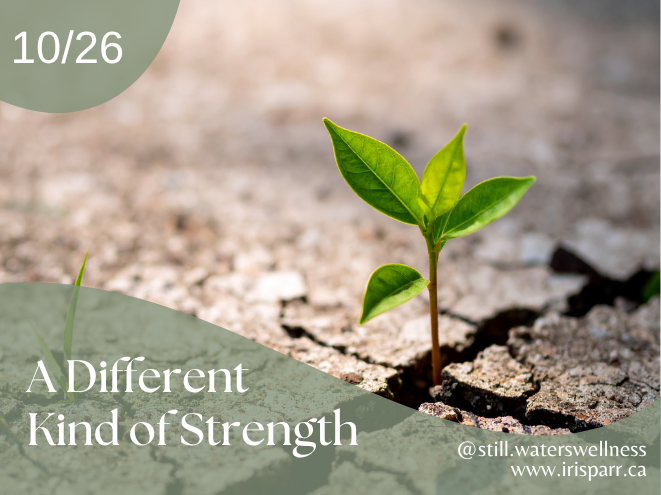
For a long time, I thought resilience meant keeping going. Be strong. Push through. Tough it out. Get back up and keep moving. Perseverance certainly has its place. Life will bring hard things, and sometimes we need the determination to keep going when we would rather stop. But over time, I have started to see resilience differently. Being resilient doesn’t mean we have to pretend something isn’t difficult. It doesn’t mean we shouldn’t grieve, feel disappointed, ask for help, or take a break. Sometimes, constantly pushing forward can take us further away from what we need.
I believe there is a healthier kind of strength—authentic resilience.
What Is Authentic Resilience?
Authenticity is about being aware of our own thoughts, feelings, needs, and experiences and living in a way that is reasonably consistent with who we are, what we believe and value. Research by Reed and colleagues (2021) found that authenticity was linked to resilience in people experiencing chronic pain and posttraumatic stress disorder.
This doesn’t mean authenticity automatically makes us resilient, or that being honest about how we feel makes difficult circumstances disappear. Instead, it offers an important perspective: resilience does not have to require hiding what we are experiencing. Authentic resilience gives us room to notice what is really happening and then decide how we want to respond.
Sometimes resilience means continuing.
Sometimes it means resting.
Sometimes it means asking for help.
Sometimes it means changing direction.
And sometimes it means acknowledging, This is really hard right now.
That is not weakness. It is awareness.
Resilience Is Something We Can Practise
Another important shift is recognizing that resilience isn’t simply a personality trait that some people have and others don’t. Resilience develops through interactions between individuals and the systems and relationships around them (Masten et al., 2021).
In other words, we can develop skills that help us navigate difficult experiences.
Three skills I think are especially important are grounding, reframing, and connection.
1. Grounding
When something feels overwhelming, our first need may not be to figure everything out. We may need to help ourselves feel a little more settled first/grounded.
Grounding can look different for everyone:
- Taking a few slow breaths
- Putting your feet firmly on the floor
- Going for a walk
- Stepping outside
- Stretching
- Paying attention to what you can see, hear, and feel
- Taking a short break
- Talking to someone you trust
Sometimes a simple reminder can help: I don’t have to solve everything right this second. Grounding isn’t avoiding the problem. It gives us some space to respond instead of simply reacting.
This is also something we can teach children. Telling a child to “calm down” doesn’t teach them how to calm down. Sitting with them, helping them name what they are feeling, breathing together, and discovering what helps their body settle gives them a skill they can use again.
2. Reframing
Reframing doesn’t mean pretending everything is positive. It means making room for another way of looking at what is happening.
Imagine you are looking through a window at a rainy day. Your first thought might be: “This day is ruined.” Reframing doesn’t mean pretending the rain isn’t there. The rain is still there. Instead, you might shift your perspective: “This isn’t the day I planned, but I can still find something meaningful in it.” The situation hasn’t changed. Your perspective has. That is what reframing can look like in resilience. We notice the thought we are having, pause, and ask: “Is there another way I could look at this?”
Instead of: “I can’t do this.”
We might try: “This is really hard, but I can take the next step.”
Instead of: “I completely failed.”
We might try: “That didn’t go the way I hoped. What can I learn from it?”
Instead of:
“I’m not strong enough.”
We might try: “I’m struggling right now, and struggling doesn’t mean I’m weak.”
Research has found a positive association between the ability to reconsider how we interpret an experience and personal resilience (Stover et al., 2024). Reframing doesn’t change what happened. It can change how we understand what happened and what we believe is possible from here.
3. Connection
One of the biggest misconceptions about resilience is that being resilient means being independent. It doesn’t. “I need help” can be a resilient response. People are not meant to navigate everything alone. Relationships, communities, and supportive environments are key to how resilience develops (Masten et al., 2021).
This is especially important for children and teenagers. We want them to know: You can handle hard things. But we also want them to know: You don’t have to handle hard things by yourself. A resilient child can be sad and still be okay. They can be disappointed and recover. They can be scared and still take the next step. They can need help and still be strong.
What Are We Teaching Our Children and Teens About Strength?
This is something I think about as a parent. We naturally want our children to be strong enough to handle the challenges life will bring. But strength doesn’t have to mean teaching them to push their feelings aside or simply “get over it.” Instead, we can help them develop the skills to understand themselves and respond to difficult experiences.
- We can teach them that emotions are information, not something to be ashamed of.
- We can model taking a break when we need one.
- We can show them what asking for help looks like.
- We can help them find words for difficult or big feelings.
- And we can remind them that struggling does not mean they are failing.
We don’t have to remove every difficult experience from our children’s lives. We can give them opportunities to develop confidence while also letting them know that support is available when they need it.
Growing Stronger, Not Just Tougher
I still believe there are times when we need to tough it out. There are seasons when we have to persevere, keep going, and do the next hard thing. But I don’t want that to be the only definition of strength. I want resilience to include knowing when to keep moving and when to pause. Knowing when to push forward and when to ask for help. Knowing when something needs to be accepted and when something needs to change. Authentic resilience isn’t about becoming someone who can withstand anything. It is about developing the awareness and flexibility to recognize what we need and respond in a way that helps us move forward. Maybe growing stronger isn’t always about becoming tougher. Maybe sometimes it is about becoming more honest with ourselves, more connected to others, and more willing to use the skills and support available to us.
That is the strength of authentic resilience.
References
Masten, A. S., Lucke, C. M., Nelson, K. M., & Stallworthy, I. C. (2021). Resilience in development and psychopathology: Multisystem perspectives. Annual Review of Clinical Psychology, 17, 521–550. https://doi.org/10.1146/annurev-clinpsy-081219-120307
Reed, D. E., Lehinger, E., Cobos, B., Vail, K., Nabity, P., Helm, C., Galgali, P., & McGeary, D. D. (2021). Authenticity as a resilience factor against COVID-19 threat among those with chronic pain and posttraumatic stress disorder. Frontiers in Psychology, 12, 643869. https://doi.org/10.3389/fpsyg.2021.643869
Stover, A. D., Shulkin, J., Lac, A., & Rapp, T. (2024). A meta-analysis of cognitive reappraisal and personal resilience. Clinical Psychology Review, 110, 102428. https://doi.org/10.1016/j.cpr.2024.102428
Leave a Reply